
Holy Saturday, Litany and epitaph.
Litany of Saint Spyridon’s miracle of panoli and epitaph of Christ of st Spyridon church. After the Litany the impressive custom of ”Breaking of Botides” take place with filharmonics marching in the narrow streets.


Litany of Saint Spyridon’s miracle of panoli and epitaph of Christ of st Spyridon church. After the Litany the impressive custom of ”Breaking of Botides” take place with filharmonics marching in the narrow streets.

In 1814 Corfu, along with the Ionian Islands became a British Protectorate. The High Commissioner of the day along with the soldiers required a place of worship. A chapel was erected in the Old Fortress by the soldiers at the foot and to the south of the eastern peak: it was built in the Doric style and was named St George. St George being the patron saint of England (garrison church). It was the garrison church until 1864. With the unification of Corfu (and the other six Ionian Islands) with Greece, the parliament in Athens wanted the old fortress to become a military base; they also realized that they had to find an alternative place of worship for the British community in exchange for St George’s which became an Orthodox Church. The Greek government offered the former Ionian Parliament building. This conditional gift was ratified by Greek law in an Act of Parliament in 1869 when the building was bequeathed to the ‘British community of Kerkyra of the Anglican faith so long as it might serve as a house of worship of the said persuasion”. The deed of consecration was signed in 1870. The Ionian Parliament became the Anglican Church and the premises to the rear was the parsonage (chaplain’s residence).
Holy Trinity Church is in a unique position whereby it does not belong to the British Government nor does it belong to any ecclesiastical body, but solely and entirely to the Anglican community in Corfu.
A Corfiot architect John Chronis built the Ionian Parliament building in 1855 in a neo-classical style with a Doric portico, this building was to replace an older building, used as the Ionian Assembly, which was destroyed by fire in 1852. The church flourished from 1869 having a chaplain permanently installed until 1940. For 71 years the Church served the numerous British residents. At the outbreak of the Second World War when most of the British populace departed, the Commonwealth & Continental Church Society (now ICS), was appointed trustee of the Church. During the war the church was bombed and gutted, leaving only parts of the outside walls. Although the parsonage to the rear suffered considerable exterior damage from the bombs, it was able to provide shelter for the Maltese community who occupied the building, preventing pilfering for the duration of the war and they carried out emergency repairs. They also salvaged whatever they could from the derelict church. Some of the Maltese were members of the Britannia Association who held their meetings regularly here until the 1980s. We, the present congregation of Holy Trinity wish to convey our thanks and heartfelt gratitude for those Maltese who saved this building for our use today.
By 1950 the British community had still not returned to the island and the mayor of Corfu taking advantage of this, requested the derelict church to be handed over to the Municipality of Corfu in order to restore it. Although this was not legal the then Bishop of Gibraltar and the Embassy in Athens consented. The restoration was completed in 1962.
Later, through various negotiations, the residence part of the building was retained, repaired and served multi-uses as Vice Consulate, community centre for the Catholic Maltese, a place of worship for Anglicans and storage rooms for numerous packing cases belonging to the British Council. Major John Forte, who was Vice Consul, set about putting some order into this situation.
His first action, after getting rid of the packing cases, was to nail up a notice announcing that Holy Trinity was open daily during the week for public worship from 9 until 1. At that time chaplain’s visits were very infrequent, but by the end of 1970, ICS decided to provide ministry on a more permanent basis. The consulate had to move and the living quarters were required to house a permanent chaplain. An ingenious engineer who suggested lowering the ceilings in the downstairs rooms skilfully turned the servant’s quarters into suitable living accommodation in preparation for seasonal chaplains. On Easter Day 1971, Holy Trinity Corfu was reopened on a permanent basis for the first time in 31 years. Major Forte became churchwarden and he retained this position until 1975.
Major Forte was appointed Honorary Life Governor by the Commonwealth & Continental Church Society in June 1971. He became famous for reviving the game of cricket in Corfu after the Second World War and helping to prevent L Ron Hubbard, the founder of Scientology, from setting up a university on the island in 1968. (Read John’s book ‘The Commodore and the Colonels’). Major Forte died August 2012
Many people have been wonderfully used to ensure that the gospel message is faithfully proclaimed. Among those are Margaret Woodley who took over from Major Forte as churchwarden in 1975 and was awarded the MBE by Her Majesty the Queen in February 1999, ‘for services to Holy Trinity Corfu’. Margaret Woodley died in London, June 2013.
Lady Majorie Holmes was also honoured in April 2011 when she was presented with the Royal Maundy Money by Her Majesty the Queen at Westminster Abbey. Her citation for that award said “Lady Marjorie was deeply involved with re-establishing regular worship at Holy Trinity Corfu. Vocal on behalf of the church in gaining financial support, her own generosity has been unparalleled. She has served for many years on church council, as churchwarden and Archdeaconry Synod representation. She is a renowned artist, writer on Mediterranean flora. She has hosted public concerts for fund raising in her home and offered hospitality to a wide range of visitors to the chaplaincy.” Lady Majorie died January 2012.



Timetable Bus No 15 from Port (parking) to Corfu Town: 15-port
(https://astikoktelkerkyras.gr/en/itineraries/)


Timetable Bus No 15 from Airport (National Stadium Parking Area) to Corfu Town): No15-airport
(https://astikoktelkerkyras.gr/en/itineraries/)
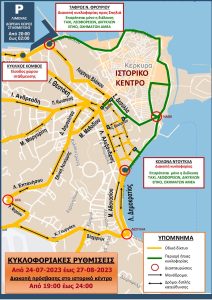
Implementation of pilot light traffic measures in Historical Center of Corfu. After consultation with the productive bodies and the associations of permanent residents, but also with the aim of improving the image of the historic center of Corfu, the Municipality of Central Corfu and the Traffic Authority formulated a comprehensive plan of soft traffic interventions in the center of Corfu. The measures are of a pilot nature, they will be updated and evaluated continuously. They aim to end the images of traffic congestion, to end the suffering of citizens and visitors.
Specifically:
– In the historic center of Corfu from 20:00 in the afternoon till 23:59 in the evening, from Wednesday August 4th to Sunday August 27th, vehicle access is prohibited and will only be allowed:
a) permanent residents, two-wheelers, taxis and public transport.
b) disabled vehicles, Security Forces, Fire Brigade and ambulances.
With the implementation of the above regulations, the entire historic center is transformed into a low-traffic area.
Parking In order to facilitate visitors as well as citizens from the implementation of the mild traffic measures, for the time being there will be a parking area (250 positions) in the new Harbour area, which will be free of charge. Entry and exit to the parking area will be made exclusively from the roundabout at the newport. The space will be available for free parking from 20:00 to 02:00.
Corfu City Bus (No 15) There is a bus station outside of the (Port) parking area (Next to HOTEL ATLANTIS towards to corfu old town).
Timetable: No15-port-old town
*More private and public parking spaces, see here:

https://greenbuses.gr/routes-en
The intercity buses of Corfu are the most popular way to get to know the island.
Green buses will take you safely and quickly to any part of Corfu.
The green buses connect Corfu town with every part of the island and also connect
Corfu Island with the biggest cities in Greece. Green buses are being chosen every day
from local and foreign travelers, for safe, secure, fast and easy journeys.
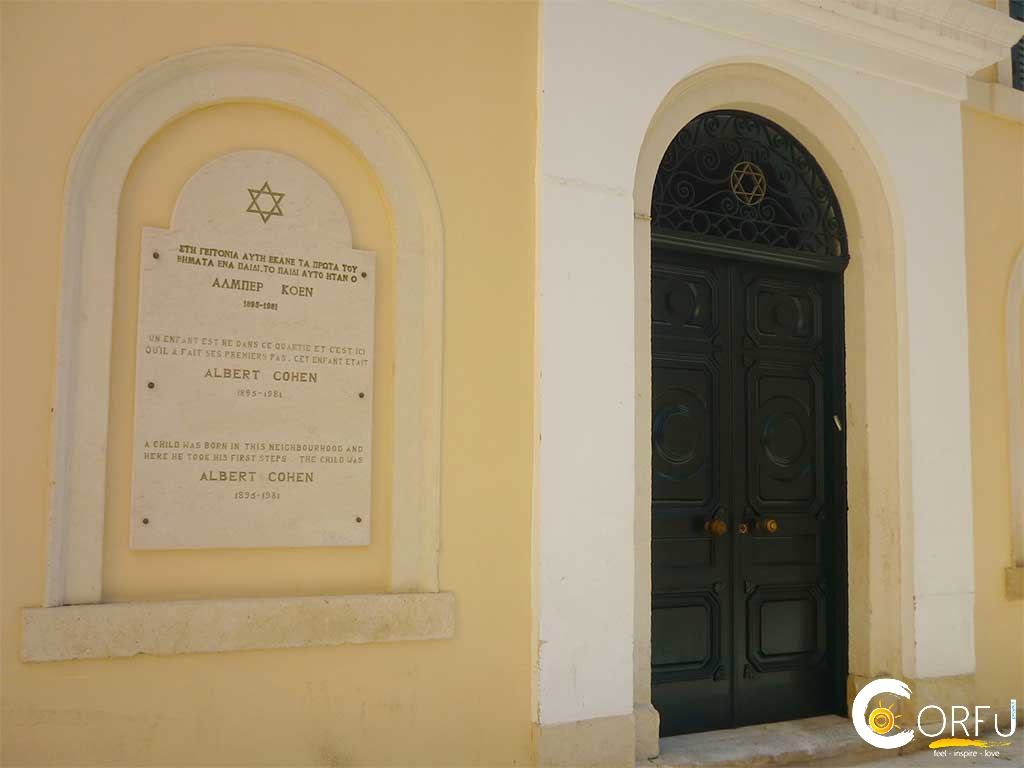
Despite Corfu’s proximity to mainland Greece, where Jewish communities have existed since ancient times, the Jewish presence on the island was first recorded by Benjamin of Tudela in 1148 and the reference involved just one person, a dyer, named Iossif. Corfu was at the time under the rule of King Roger of Sicily, before briefly passing to the despot of Epirus, Michael I Komnenos Angelos, in 1214 and then the Angevin king, Charles I of Anjou, for the next 120 years (1267-1386). At that time the first mass settlement of Jews on Corfu took place. In 1267 there already were a few hundred present, hailing from the lands of the Byzantine Empire as well as from Apulia (Puglia) in Italy.
The local population was quite disturbed by their presence, as can be inferred from a series of decrees (1317, 1324, 1370) that sought to protect them from the violent attacks and frequent humiliations at the hands of locals. Although Angevin rule was in principle benign, it was largely absent, which left the Jewish community vulnerable to petty harassments by the local magistrates. It was in this period that a Jewish neighbourhood was first mentioned. However, the community enjoyed a much better situation than those in Central Europe at the same time. Jews even managed to reach high administrative positions, especially under the reign of Charles III, when they were granted certain privileges. Some members of the community even participated in official delegations from the island to the kings in Naples. When, in 1386, the Corfiots, tired by the constant dynastic struggles for the throne of Naples, sent a delegation to Venice to submit a request for annexation, the Jew David Semos was one of its six members.
Union with Greece
The Treaty of London (29 March 1864) recognised the Ionian Islands as a greek province. The High Commissioner officially proclaimed the Union of the Islands with Greece on 21 May 1864. Initially, the position of the Jewish community improved significantly. The island’s Jews were granted full political and civil rights, as Greek citizens. They could henceforth take part in community matters, run for election and actively participate in social and political life. These new conditions led to a flowering of the community, culturally and financially. Most families were now pretty affluent and the community boasted a number of schools, as well as a nursing home for the elderly. In 1925 a rabbinical school was founded, while a Talmud Torah school operated until the beginning of the 20th century. Rabbi Abraham Schreiber and the teacher Moissis Chaimis founded a night school for destitute pupils. Despite this good atmosphere, the traditional discord between the Greci and the Pugliesi, though muted, continued to burn underneath, despite the best efforts of Rabbi Schreiber, as well as those of his successor, Rabbi Yaacov Nechama. The two communities even maintained separate benevolent institutions.
More info…
https://www.jewishmuseum.gr/en/religious-life-the-apulian-synagogues/#RL
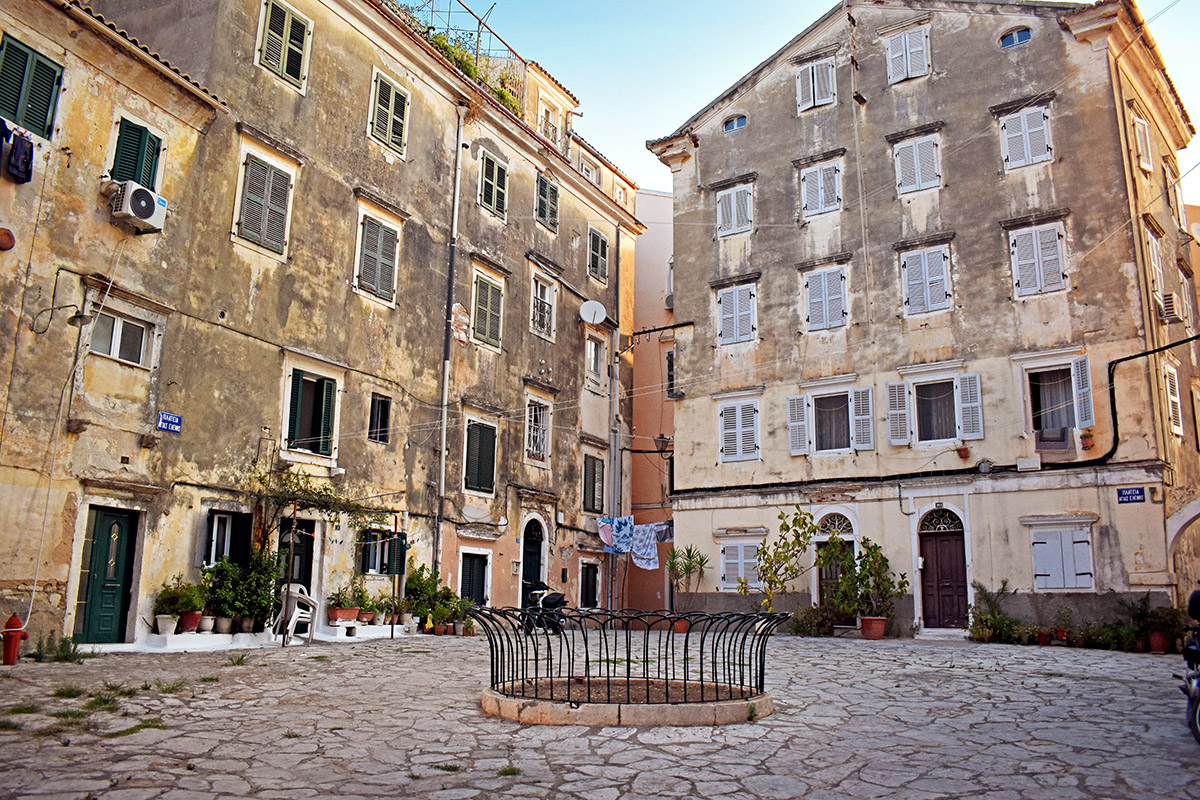
From Agiou Spyridonos street, the narrow alleys, “kantounia” as the locals call them, lead to one of the most authentic neighbourhoods of Corfu, the Kampielo area. It is one of the oldest quarters and has managed to maintain its architecture. The shady passageways take us to small squares, picturesque taverns and flower gardens! The old multi-storey houses with theis terracotta paint peeling off ( an umistakable sign of the passage of time), the old ladies hanging theis laundry on the stretched ropes between the houses, the narrow sunless alleys, all exude a special atmosphere!

The Kanoni site lies to the south of Palaeopolis. It is said that it took its name from the establishment of two French cannon there in 1798. One cannon from that battery still survives. Just below Kanoni there is the Monastery of Vlachernae, dating to the 1600s. Small boats sail from the quay to the islet of Pontikonissi with its picturesque Chapel of the Pantocrator.
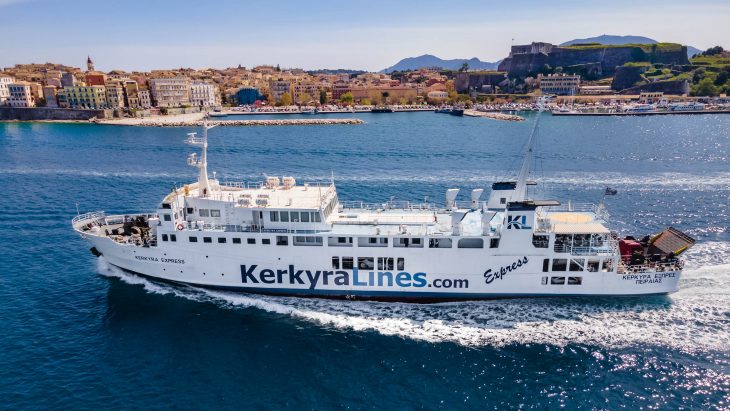

Check out the daily ferry timetables and travel to Corfu – Igoumenitsa – Paxos – Diapontia Islands with Kerkyra Lines.
Kerkyra Lines is a Ferry Consortium, which operates on the Corfu – Igoumenitsa – Paxos line, executing daily routes since 2010 and on the Corfu – Diapontia Islands line since 2021. Our constantly evolving course through time, results from both our fleet’s growth and the continuous improvement of the provided services.
Kerkyra Lines’ mission is to cover the transportation needs of Corfu, Paxos and Diapontia Islands and maintain the Corfu – Igoumenitsa, Paxos – Igoumenitsa and Corfu – Diapontia Islands lines operational at all times, even in adverse weather conditions.
Our goal is to contribute to the development of Corfu and its neighbouring islands, by offering upgraded maritime transport services to both permanent residents and visitors
https://kerkyralines.com/en/route/

Under the shadow of the Venetian Castle, in the heart of the town, dozens of local producers sell their products. Fresh fish and seafood, vegetables, local products and traditional sweets, fresh herbs straight from their gardens fill the stalls.

There are some luggage store points that you can drop off your luggages for a few hours. See the following list:
Services: